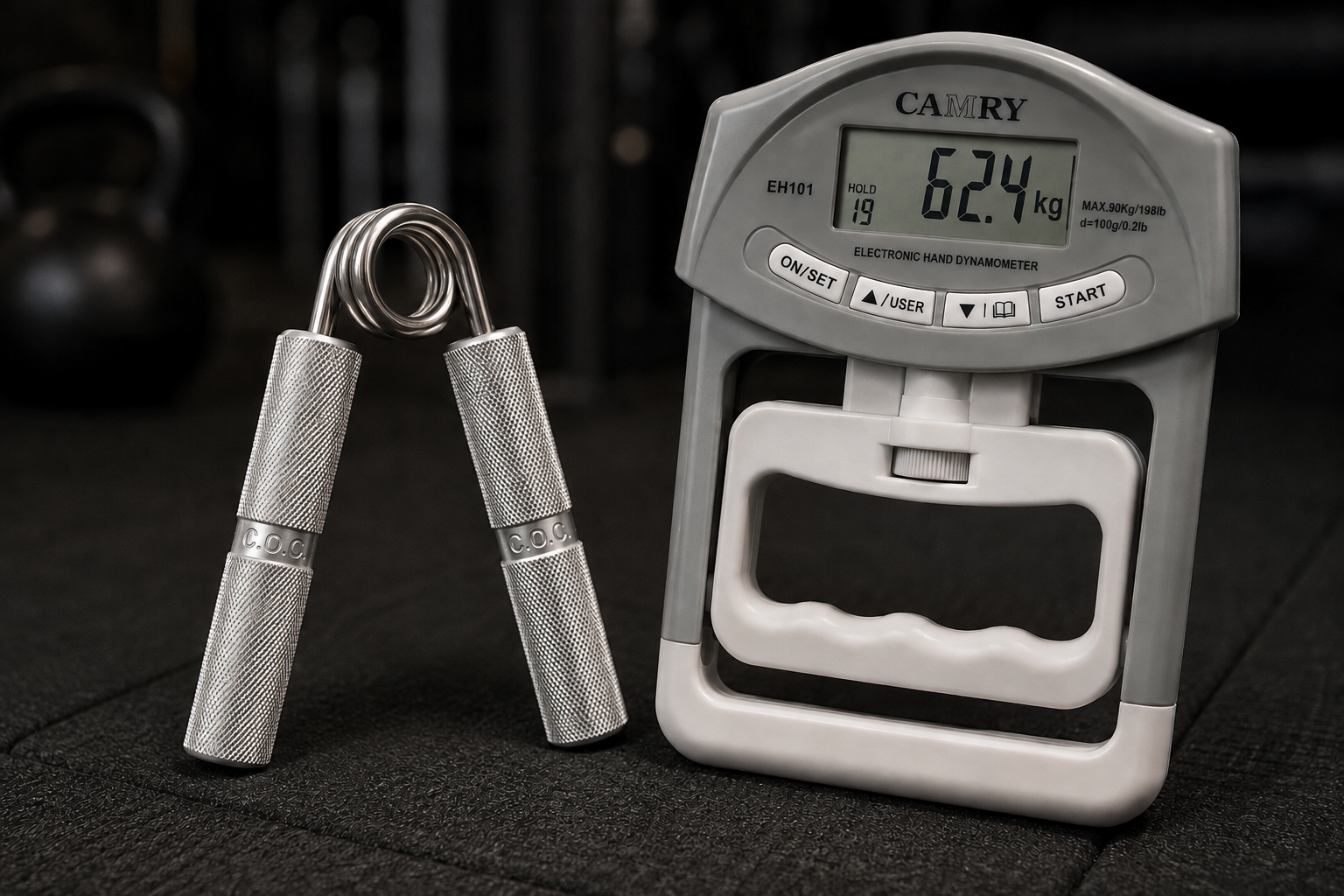
Using Captains of Crush Grippers to Train for a Job Grip Test
Build the Grip Strength You Need to Pass With Confidence
Many jobs require applicants to demonstrate practical physical strength, and one common assessment is a grip strength test. Whether the test is part of a police, defence, emergency services, trades, industrial, or manual-handling recruitment process, improving your grip strength can give you an important advantage.
One of the most effective tools for developing crushing grip strength is the Captains of Crush (CoC) gripper. These heavy-duty hand grippers allow you to progressively increase resistance and specifically train the muscles involved in squeezing and holding objects.
Why Grip Strength Matters
Grip strength isn’t just about having strong hands. Your fingers, thumb, forearms and wrist all contribute to your ability to produce and maintain force.
A strong grip can help with:
- Performing better in grip strength assessments
- Holding tools and equipment securely
- Carrying and lifting objects
- Improving endurance during physically demanding work
- Reducing grip fatigue
- Building confidence before a physical employment test
The key is to train specifically for the demands of your test rather than simply squeezing a gripper as hard and as often as possible.
Why Captains of Crush Grippers?
Captains of Crush grippers are designed around progressive resistance. Different grippers provide different levels of difficulty, allowing you to gradually develop your strength.
The important principle is progressive overload: as your grip becomes stronger, you increase the resistance or difficulty of the exercise.
A gripper that is far too difficult to close provides little benefit if you cannot perform the movement correctly. Conversely, a gripper that you can close dozens of times may not provide enough resistance to significantly improve your maximum strength.
For job-test preparation, it is useful to train across several levels:
Easy gripper: Warm-up and high-repetition work
Moderate gripper: Strength and volume training
Heavy gripper: Maximum-strength practice
Start by Finding Your Baseline
Before beginning a program, determine what level of gripper you can realistically close with good technique.
Don’t start by repeatedly attempting the hardest gripper you can find. Instead, work up gradually from an easier resistance.
Your baseline might look something like:
- 10 controlled repetitions with your easier gripper
- 5–8 repetitions with your working gripper
- 1–3 difficult repetitions with a heavier gripper
The exact numbers will vary considerably between individuals.
If your employment test uses a dynamometer or another type of grip-strength device, remember that closing a CoC gripper and producing a high score on a dynamometer are related but not identical skills. CoC training can build valuable hand and forearm strength, but you should also practise the actual testing position and equipment whenever possible.
A Simple Training Program
A straightforward program can be performed two or three times per week.
Session 1 – Strength
Begin with a thorough warm-up using an easy gripper.
Then perform:
Warm-up: 2–3 sets of 10 easy repetitions
Working gripper: 3–5 sets of 3–6 repetitions
Heavy attempts: 2–3 sets of 1–3 repetitions if appropriate
Optional holds: 2–3 controlled holds
Rest approximately 2–3 minutes between challenging sets.
The goal isn’t to destroy your hands. The goal is to produce strong, high-quality contractions and gradually become stronger.
Session 2 – Volume and Endurance
Use a lighter gripper and focus on controlled repetitions.
For example:
Warm-up: 2 sets of 10
Working sets: 3–4 sets of 8–15 repetitions
Final set: Controlled repetitions without forcing your hand to failure
This session develops the ability to repeatedly produce force and can help improve grip endurance.
Session 3 – Test Preparation
If you have a grip test coming up, dedicate one session to practising the type of effort required.
If your test requires a single maximum squeeze, practise short, powerful contractions.
If it requires maintaining a grip for a period of time, incorporate timed holds.
If it involves multiple attempts, practise producing a strong effort repeatedly while maintaining good technique.
Don’t Train Your Grip Every Day
One of the most common mistakes is assuming that grip muscles need to be trained constantly because the exercises are small.
Your hands and forearms still need recovery.
Heavy gripper training can place significant stress on the fingers, tendons, forearms and elbows. Allowing recovery between hard sessions can be just as important as the training itself.
For most people preparing for a job test, two or three dedicated grip sessions per week is plenty, especially when combined with normal work, gym training, sport or other physical activity.
If you develop persistent pain rather than normal training fatigue, stop the aggravating exercise and seek appropriate professional advice.
Train Both Hands
Don’t neglect your weaker hand.
If your job test requires both hands to be assessed, train them individually and keep track of your progress.
You may find that your dominant hand is considerably stronger than your non-dominant hand. Bringing the weaker side closer to the stronger side can improve overall performance.
A simple approach is to start each session with your weaker hand and then match the same work with your stronger hand.
Use Good Technique
Technique matters when training with heavy grippers.
Keep your wrist relatively stable and position the gripper comfortably in the hand. Avoid twisting the wrist or using excessive body movement to force the gripper closed.
For maximum-strength attempts, quality is more important than quantity.
A controlled repetition with a challenging gripper is generally more useful than repeatedly performing sloppy repetitions simply to accumulate numbers.
Progress Gradually
Don’t rush from one gripper to the next.
A useful progression might be:
Build repetitions → build control → increase resistance → repeat
For example, if you can comfortably perform several sets of repetitions with your current working gripper, you can gradually introduce a harder gripper.
You can also use partial closes, negatives or assisted repetitions as supplementary exercises when appropriate, particularly when working toward a resistance level that you cannot yet fully close.
Combine Gripper Training With Other Grip Exercises
Captains of Crush grippers are excellent for crushing grip, but a complete grip program doesn’t need to rely exclusively on them.
Consider including:
- Farmer’s carries
- Dead hangs
- Plate pinches
- Barbell or dumbbell holds
- Wrist extension exercises
- Wrist curls
- Towel or thick-handle holds
These exercises train different aspects of hand, wrist and forearm strength.
For someone preparing for a specific employment assessment, however, the actual test should remain the priority. Your training should reflect what you will be asked to do.
The Final Weeks Before the Test
As the test approaches, avoid suddenly increasing your training volume.
The objective is to arrive at the assessment strong and recovered, not exhausted from last-minute training.
During the final week, reduce heavy training and allow your hands and forearms plenty of recovery. A short, light session several days before the test can help you stay familiar with the movement without creating unnecessary fatigue.
On test day, follow the instructions provided by the testing organisation and use the exact technique required. Even a strong grip can produce a disappointing result if your hand position or testing technique doesn’t meet the assessment requirements.
Track Your Progress
Keeping a simple training log can make your preparation much more effective.
Record:
- Gripper resistance
- Number of repetitions
- Sets completed
- Best successful close
- Timed holds
- Left-hand performance
- Right-hand performance
- How difficult the session felt
Over several weeks, you should be able to see whether your strength is improving.
Train Smart, Test Strong
Captains of Crush grippers can be an excellent tool for preparing for a job grip test because they allow you to train hand and forearm strength with progressively heavier resistance.
The most important factors are consistent training, progressive overload, good technique and adequate recovery.
Don’t simply squeeze a gripper hundreds of times every day. Instead, train with purpose, gradually increase the challenge and, most importantly, practise the specific type of grip test you will actually face.
With a structured approach, your grip can become significantly stronger—and you can walk into your employment assessment knowing that you have prepared for it properly.